
Clan mating (also called spiral mating) is a breeding method which allows for keeping a closed flock.
How Does it Work?
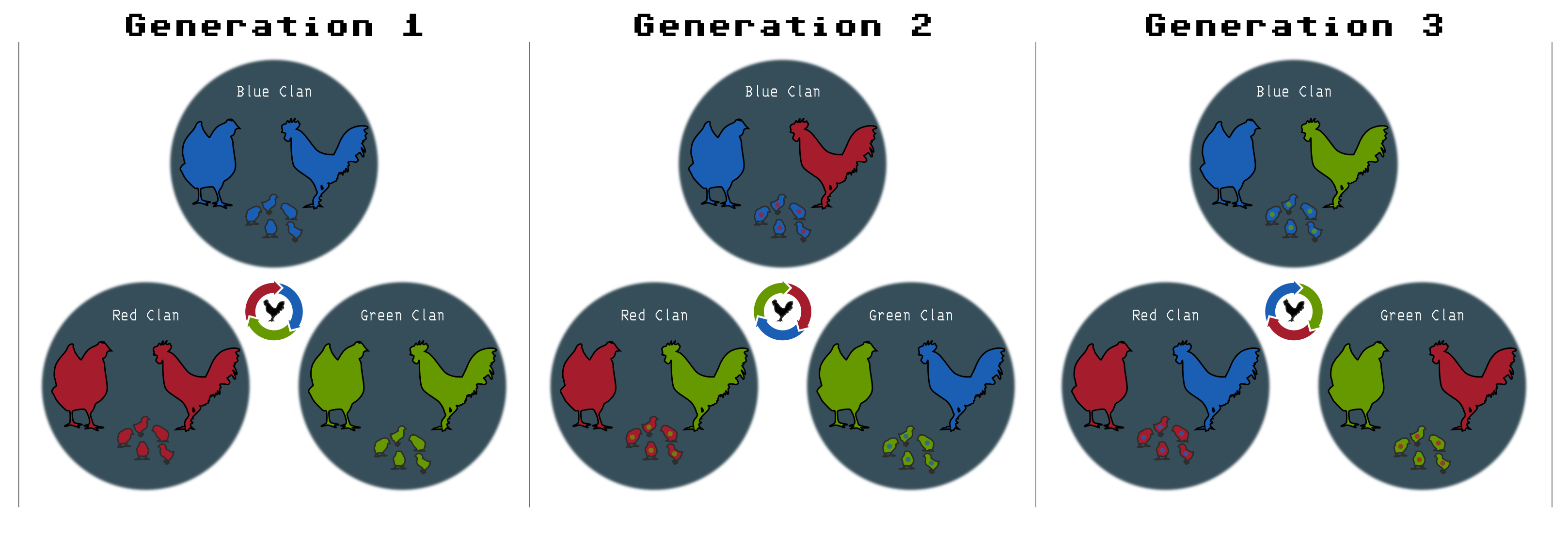
Clan mating operates on the following rules:
- Chicks take on the clan of their mother
- Roosters go on to the next clan to mate
So the best rooster born to clan 1 in a given generation will move on to clan 2 to sire the following generation of chicks. From this generation will be chosen the best rooster to move on to clan 3, and so on.
How Many Clans?
In a three-clan system the closest genetic relative that the rooster can mate with is a great aunt (12.5% shared DNA) and the most distant is a second cousin (3.13% shared DNA)
In a three-clan system, by the fourth generation the genetic material has come full circle and mating between relatives begins. If the previous generations have not been culled, the rooster has the opportunity to mate with second cousins, first cousins once removed, and great aunts.
| Relationship | Shared DNA |
|---|---|
| Great aunt (gen 1) | 12.5% |
| First cousin once removed (gen 2) | 6.25% |
| Second cousin (gen 3) | 3.13% |
Assuming even numbers from each of the generations, this would result in matings between chickens that have 7.3% of their DNA in common.
A five-clan system will run five generations before reaching full circle, and this would result in (also using the conservative assumption of even numbers across the generations) an average shared DNA of 1.21%.
| Relationship | Shared DNA |
|---|---|
| Great great grand aunt (gen 1) | 3.13% |
| First cousin thrice removed (gen 2) | 1.57% |
| Second cousin twice removed (gen 3) | 0.78% |
| Third cousin once removed (gen 4) | 0.39% |
| Fourth cousin (gen 5) | 0.2% |